
The Culture of Urban Living
The Culture of Urban Living
The Croatian short film form often resides in the interiors of apartments. Of course, easily controlled conditions and affordable production are important, but not the only reasons why apartments continue to be a source of inspiration. Often enough, the oases of peace within the concrete jungle are anything but – a fact known to anyone who has ever renovated their home, moved house, decided to live with a roommate or listened to noisy neighbors on the other side of the wall.
The person you live with has the ability to turn the walls of your shared apartment into a genuine prison. However, the others are not always the problem: films such as Zvonimir Jurić’s Yellow Moon (2009), Hana Jušić’s Terrarium (2012), Bill Collector (2009) by Igor Mirković, and The Beast (2015) by Daina O. Pusić’s, reveal that, sometimes, consciously or not, we use our living space as a way of shutting ourselves from the world, effectively becoming our own jail keepers.
Back in 1962, Zvonimir Berković’s film My Flat, awarded the Short Film Special Jury Prize at Cannes, told a micro-story about a family moving into a newly-build Zagreb neighborhood, casting a critical eye on the discrepancies between the values of a political utopia and their manifestation in real life. The culture of urban living as a poignant critique of society is still present in Croatian short films. Darija Blažević’s Teeth (2011) is an urban mystery whose protagonist caught in a conformist trap of pastel façades of a Zagreb neighborhood. Similarly, Sonja Tarokić’s On Shaky Ground (2014), situated in a Split neighborhood, Split 3, illustrates that no interior is so small that it cannot hold within itself tectonic social shifts, from the breakdown of the socialist project, to the crisis of the nuclear family and the traditional concepts of patriarchy and manliness.
In short, in our film archive there are many addresses whose tenants face these or similar questions. Here we offer you a selection of three disparate cinematic recommendations you can visit any time, should you decide to explore the topic of the culture of urban living.
Mladen Stanić
Lately, the topic of how tourism and sharing economy are changing the cities’ social and urban structure is increasingly present in public debate. In the context of Croatia, Split is the epitome of this trend. It is almost impossible to find an apartment with a long-term lease, because the landlords prefer to rent to the tourist, who come during summer months for their dose of the “Adriatic as it once was.” That is precisely why, after their mother’s death, the protagonists of White Room decide to paint the walls of their family apartment a fashionable pink, so they could charge ten more euros per night.
As often happens, the apartment renovations also disturb some of the family skeletons in the closet, since Stanić’s film is primarily a story about two estranged brothers reconnecting. It is equally an urban elegy in which the anxiety of intimate relationshipss becomes a synecdoche of the society-wide anxiety brought on by the changes in the urban, social and economic fiber of the city. The film, effectively blending the intimate and the universal and aided by subtle acting performances by Paško Vukasović and Marin Klišmanić, earned Stanić the Golden Pram Award for Best Film in the ZFF 2018 Checkers program.
Ana Horvat
The subjective experiences of architecture, urbanism and culture are not only the topic of exploration of fiction and documentary film, but are also often found in animation films. One such example is the unusual coming-of-age story directed by Tomislav Šoban, The Tiniest (2013), which charmingly combines stop-motion animation and the catalogue of noises from the neighborhood. Similarly, Jelena Oroz’s Two for Two (2018) is an almost Lynchesque, surreal meditation on an unbridled ego and the claustrophobic sensation of intimacy.
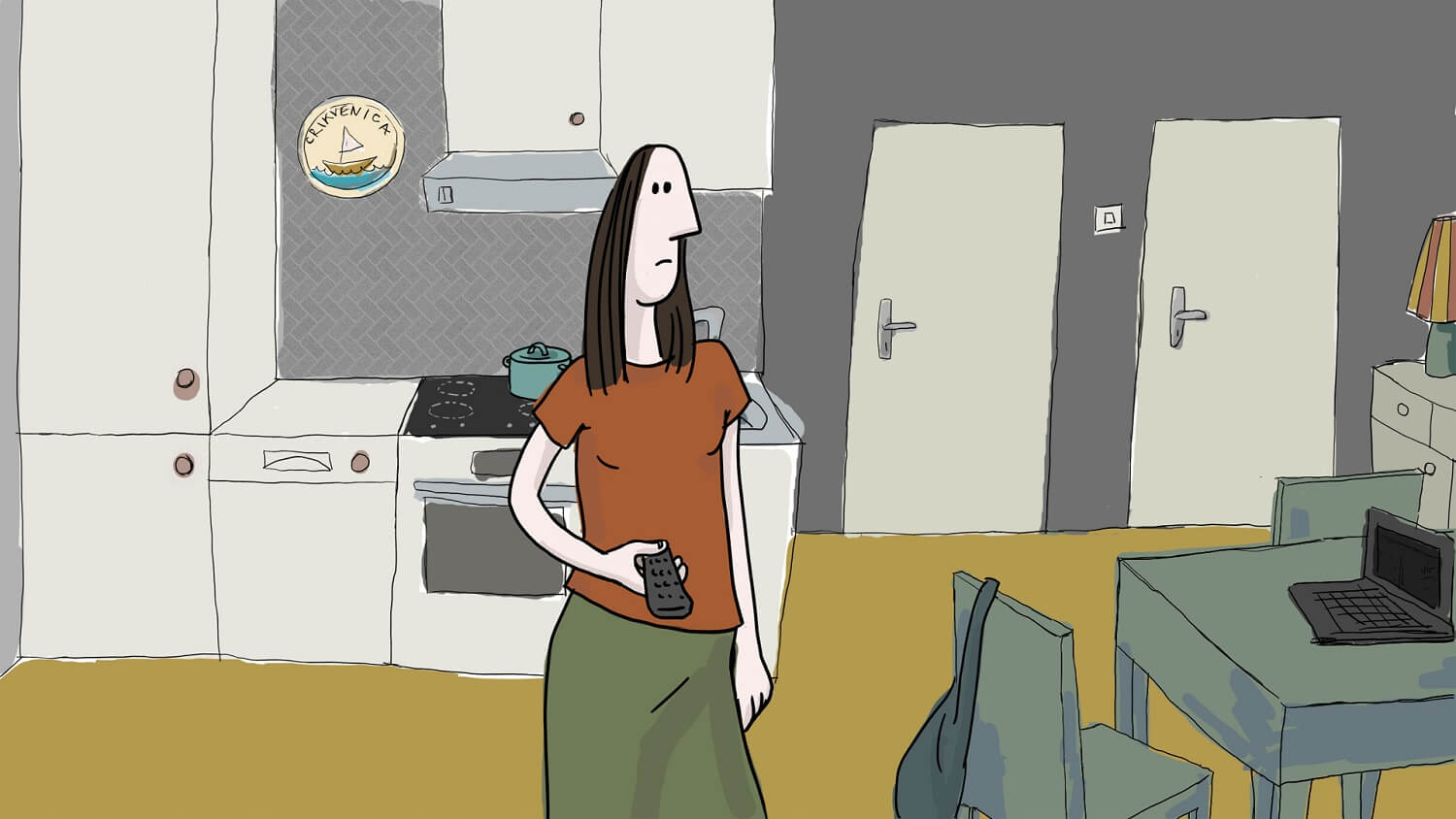
In this context, it is also worth mentioning Ana Horvat’s strange animation film, Conversation (2015), which uses the interior as a continuation of the protagonist’s feelings of exclusion form the world, society and herself. Its open-endedness and the central metaphor of a giant in the room, artfully introduced through a TV set as a “window into the world”, skillfully articulates the film’s central theme of depression – a problem that possess size, but remains without a name.
Ante Zlatko Stolica
Everyone who has ever written a project application for a city or state call for applications knows how it feels to get rejected. It happens. But, the justification accompanying the rejection letter is something else entirely. Ante Zlatko Stolica’s documentary miniature turns one such cold and factual rejection into an open question, which the team members of the rejected project return to sender. Amid the cardboard moving boxes full of unpacked things on one side, and the cramped interiors on the other, this two-piece tableau seems like a postcard from the daily life of contemporary precarious workers – a generational portrait that succinctly and effectively raises the question of the value of labor in the 21st century.